
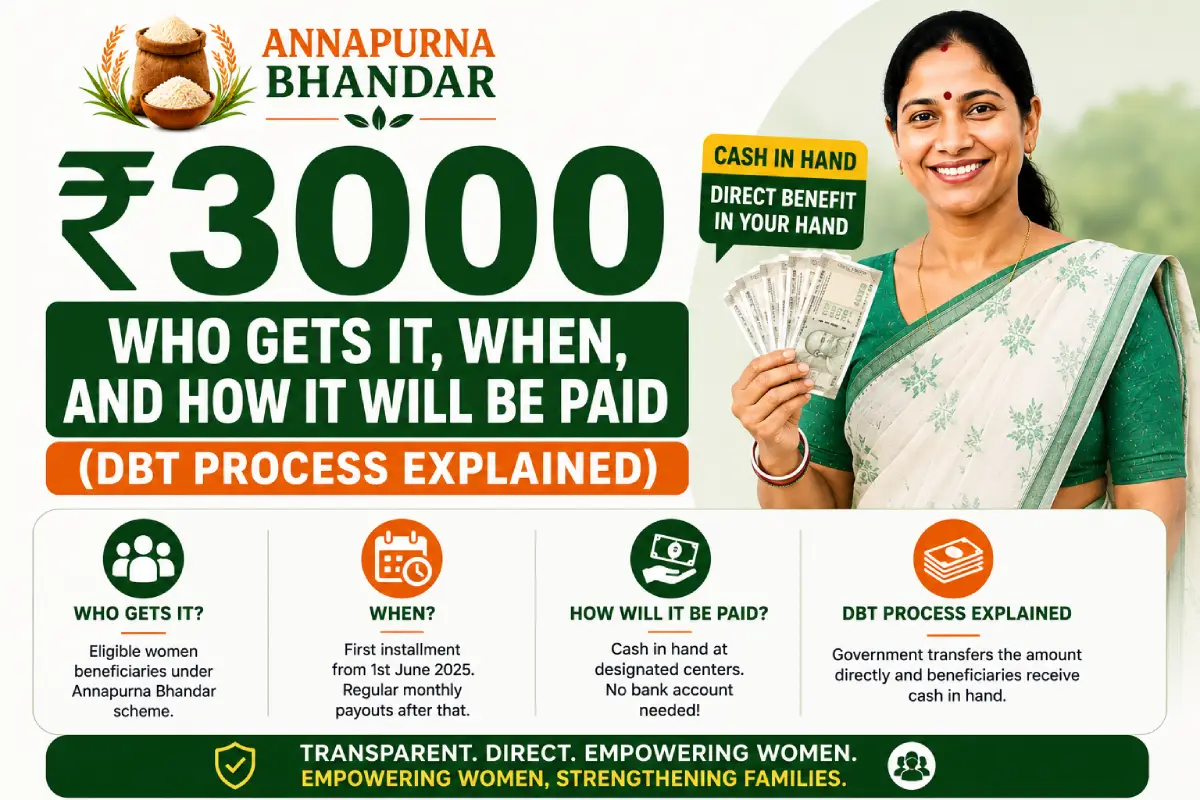
The upcoming launch of the Annapurna Bhandar Scheme on June 1st marks a massive structural shift in West Bengal’s social welfare system. With the monthly allowance scaling up to a uniform ₹3,000, public interest and search volumes have reached an all-time high.
However, as reported by major journalistic outlets like The Telegraph India, this financial upgrade comes with strict regulatory filters. While millions of women stand to benefit, specific compliance rules mean a significant number of applicants could face immediate rejection if their paperwork or banking data fails verification.
This comprehensive guide covers exactly who qualifies under the new rules, who is at risk of missing out, and how the technical Direct Benefit Transfer (DBT) pipeline handles your payment.
1. The Financial Scale: Who Gets the ₹3,000 Benefit?
Under the operational guidelines of the Annapurna Bhandar Scheme, the tier-based payout structures seen in legacy programs (such as the historical Lakshmir Bhandar framework) are being replaced with a flattened, maximized allocation.
- The Uniform Payout: Eligible female heads of households will receive ₹3,000 per month.
- Demographic Windows: The system applies a rigid age barrier. To submit a valid application, the female applicant must be between 25 and 60 years of age.
- Social Coverage: The allowance comprehensively spans multiple community categories, including General, OBC, Scheduled Caste (SC), and Scheduled Tribe (ST) households.
2. Who May Lose Out: Strict Exclusion Criteria
A critical report by The Telegraph India outlines that the state government is deploying precise data-matching algorithms to filter out ineligible files right at the source. If any of the following parameters apply to your household, your application will face automated rejections:
- Income Tax and Pension Barriers: If the applicant, or any active member living within the direct household unit, is a registered Income Tax payer, a regular state/central government employee, or a retired municipal/government servant drawing an institutional pension, the file is automatically disqualified.
- The “Out-of-State” Bank Account Trait: A massive pain point for rural and migratory families is the geographic location of their bank branch. The rules require that your operational bank account must belong to a bank branch physically located inside West Bengal. Accounts with out-of-state IFSC codes (even if belonging to a nationalized bank like SBI or PNB) will flag the DBT tracking system and freeze the payout.
- Deactivated Digital Ration Cards: Because household verification syncs with food security databases, possessing an inactive, non-subsidized, or unlinked Digital Ration Card (BPL/AAY/PHH) acts as an immediate processing bottleneck.
3. The DBT Payment Process Explained Clearly
The distribution network utilizes an advanced backend infrastructure called the Direct Benefit Transfer (DBT) system. This means physical cash, cheques, or local administrative hand-offs are entirely eliminated. The money transfers directly from the State Treasury into your account via electronic clearance bridges.
To ensure your name passes the automated Public Financial Management System (PFMS) validation, your bank profile must strictly meet three requirements:
A. The Solo Account Mandate (No Joint Accounts)
This remains the single biggest reason why welfare deposits bounce across the state. The bank account listed on your form must be a single account owned strictly by the female applicant.
- Joint accounts shared with a spouse, child, or family member will trigger a “Name Mismatch Alert” on the automated clearing system and immediately pause your monthly allotment.
B. Active Aadhaar-Seeding & NPCI Mapping
The state treasury routes these massive monthly allocations using the Aadhaar Payment Bridge System (APBS). Instead of traditional account-number tracking, the server matches your identification numbers.
- You must verify that your bank account is actively Aadhaar-seeded.
- Crucial Note: Handing a photocopy of your Aadhaar card to a local bank kiosk does not guarantee it is ready for government funds. You must explicitly request your branch to map the account to the NPCI (National Payments Corporation of India) mapper for DBT benefits.
4. Expected Payment Timeline & Troubleshooting
Once the registration camps clear their data pipelines following the June 1st launch, payouts are designed to move on a tight monthly cycle:
| Processing Phase | System Activity | Impact on Beneficiary |
| 1st to 5th of the Month | Treasury Compilation | Data clusters are verified by the social welfare nodes. |
| 6th to 15th of the Month | Primary Cash Drop Window | DBT servers push files; bank nodes trigger SMS alerts. |
| 16th to 25th of the Month | Failed-Transaction Cleanup | Re-processing attempts for accounts with temporary bank errors. |
What to Do If Your Bank Account Details Are Wrong?
If your neighbors receive their text confirmations but your account shows no balance, take immediate action:
- Check for “Dormant” Bank Status: If your account has had zero user-initiated activity (no small deposits or withdrawals) over the last 6 to 12 months, the bank system marks it dormant. Incoming DBT files will automatically bounce back to the government.
- Resolve Bank Merger IFSC Changes: If your local account belongs to a bank that was recently merged into a larger institution, your old passbook IFSC code is obsolete. You must update your local administrative helpdesk (BDO or Municipality desk) with the fresh, active IFSC code.